

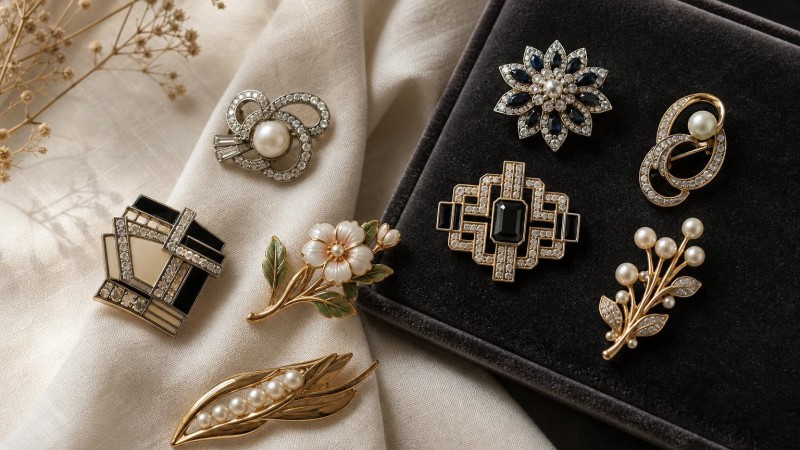
Once associated mainly with heirloom jewellery, formal lapels, and antique cabinets, the brooch has returned to contemporary wardrobes with surprising versatility. Vintage brooches now appear on tailored jackets, knitwear, scarves, bags, hats, and even unexpected placements such as shirt collars. Their resurgence reflects a broader interest in expressive accessories, craftsmanship, sustainable style, and pieces with a visible sense of history.
Part of the appeal is simple: a brooch can transform clothing without needing an entirely new outfit. Unlike jewellery designed for one fixed position, pins invite experimentation. A single vintage piece can look stately on a blazer one day and playful on a denim jacket the next. For collectors and jewellery makers alike, the revival also offers inspiration for exploring historic materials, gemstone settings, findings, and decorative techniques.
Why Are Vintage Brooches Back in Fashion?
Fashion regularly revisits earlier eras, but successful revivals rarely reproduce the past exactly. Modern brooch styling blends historical references with contemporary proportions, layering, and everyday wear. An elaborate floral pin that might once have been reserved for an evening coat can now contrast beautifully with a simple jumper or utilitarian jacket.
Individuality is another factor. Brooches range from restrained geometric designs to figurative animals, botanical motifs, cameos, bows, starbursts, and colourful gemstone compositions. Because vintage pieces vary in age, material, and manufacture, they can feel more personal than accessories built around a single seasonal trend.
The renewed appreciation for repairing, reusing, and redesigning existing objects has helped too. Wearing an older brooch extends the useful life of a piece that may already have survived for decades. Jewellery makers can also draw on vintage aesthetics when creating new designs with durable components such as brooch findings.
A Brief History of Brooches
The brooch has practical origins stretching back thousands of years. Ancient fibulae were pin-like fasteners used to secure garments, and examples survive from Greek, Roman, Celtic, and other cultures. Their forms differed considerably, but the blend of function and ornament established a pattern that would continue throughout jewellery history.
In later European periods, brooches increasingly became decorative objects as well as garment fasteners. Designs could signal wealth, mourning, affection, identity, or allegiance. Materials ranged from precious metals and gems to glass, enamel, shell, paste stones, and less costly alloys, meaning brooches existed at many levels of society.
From Victorian Sentiment to Art Deco Geometry
The Victorian era produced an especially varied vocabulary of brooch design. Flowers, insects, crescents, hearts, lockets, cameos, and sentimental symbols were popular at different times. Mourning jewellery also became highly developed. Materials such as jet and dark glass appeared in sombre pieces, while seed pearls and coloured stones featured in more decorative designs.
Art Nouveau jewellery around the turn of the twentieth century favoured flowing lines and subjects drawn from nature. Art Deco design later brought bolder geometry, symmetry, contrasting colours, and streamlined forms. Jewellery makers seeking a Deco-inspired look today might use faceted onyx beads to introduce the dramatic dark accents associated with the period’s visual language.
Mid-Century Brooches and Costume Jewellery
The twentieth century dramatically expanded costume jewellery. Brooches could be oversized, colourful, whimsical, and made with rhinestones, simulated pearls, enamel, moulded glass, or metal. Mid-century designers embraced everything from abstract sprays to birds and elaborate floral clusters. These pieces underline an important principle that still matters today: visual impact doesn’t depend solely on the intrinsic value of the material.
What Makes Vintage Brooches Feel Modern?
Context changes everything. Place an ornate pin on a traditional formal jacket and it may read as historically inspired; move the same pin to a minimal black dress, canvas bag, or contemporary oversized blazer and it takes on a different character. That contrast between old and new is at the heart of today’s appeal.
Modern styling is also less constrained by traditional rules. Brooches don’t have to sit neatly on the upper-left chest. They can be placed near a collar, used to gather a scarf, attached to a pocket area, or arranged as a small constellation. The key is balancing visual creativity with the weight of the pin and the durability of the fabric.
How to Style Vintage Brooches Today
The easiest approach is to let one distinctive brooch become the focal point. A sculptural metal pin can enliven a monochrome outfit, while a colourful gemstone design can echo a shade elsewhere in your clothing. If the brooch is highly detailed, keeping nearby jewellery relatively simple helps prevent different elements from competing.
- On blazers: Position a brooch on a sturdy lapel where the fabric can support its weight.
- On knitwear: Choose a lightweight piece and avoid loose or delicate knits that can snag or stretch.
- On scarves: Pin securely through layered fabric without forcing a thick needle through tightly woven textiles.
- On denim: Use sturdy jackets or shirts as a relaxed backdrop for ornate or sparkling pieces.
- On bags: Attach pins only to suitable fabric surfaces, avoiding valuable leather or materials that retain permanent holes.
- In groups: Combine two or three pieces around a shared colour, motif, metal tone, or era rather than clustering unrelated designs.
Another contemporary option is to mix old-looking details with natural materials. A brooch inspired by botanical Victorian jewellery, for example, can coordinate with a necklace made from garnet beads, without requiring every accessory to be from the same historical period.
Try Unexpected Placement
Placement can change the personality of a brooch. Matching small pins at the points of a shirt collar can create symmetry, while an asymmetrical pin near a jacket pocket feels more relaxed. A number of tiny brooches scattered across a substantial lapel can create a curated effect. Before committing, lay out the pieces while the garment is flat so you can judge spacing and check whether the fabric puckers.
Gemstones, Pearls, and Natural Materials
Natural stones add colour, texture, and variation to brooch designs. Agate, garnet, turquoise, amethyst, carnelian, and other materials have appeared in jewellery across different eras and cultures. When identifying a vintage piece, however, appearance alone isn’t reliable proof of a gemstone’s identity. Glass, paste, synthetic stones, and dyed materials have long been used skilfully in jewellery.
Pearls are just as important in historical and vintage-inspired design. Small seed pearls were used extensively in nineteenth-century jewellery, while larger pearl elements appear in many later styles. Contemporary makers can reinterpret these textures with freshwater pearls, pairing their natural variation with clean metalwork for a design that nods to the past without copying it.
Gemstones also carry layered symbolism. Amethyst, for instance, has traditionally been associated with sobriety, clarity, and spiritual symbolism in different historical contexts. These associations belong to cultural tradition and folklore rather than medical evidence, but they can provide interesting historical context when researching or designing jewellery with amethyst beads.
How to Evaluate a Vintage Brooch
Whether you inherit, collect, or discover an older brooch, inspect it carefully before wearing it. Start with the back. The construction, hinge, pin stem, clasp, soldering, and maker’s marks can reveal helpful information about manufacture and sometimes age. Patina can be consistent with age, but it isn’t, by itself, proof that an item is genuinely antique.
Check that stones are secure and look closely for missing prongs, cracked settings, loose components, bent pins, and previous repairs. A jeweller or qualified appraiser may be appropriate for pieces that appear valuable, fragile, or historically significant. Avoid aggressive cleaning of an unidentified item: chemicals, ultrasonic cleaning, abrasives, and even prolonged water exposure can damage certain stones, coatings, adhesives, enamels, or finishes.
Vintage, Antique, and Vintage-Inspired Are Not Identical
These terms are often used loosely in everyday fashion talk. In collecting contexts, “antique” commonly refers to objects at least 100 years old, while “vintage” is generally used for older pieces that don’t necessarily meet that threshold. Definitions can vary by market and category. “Vintage-inspired” simply describes a newer object whose design references historical styles.
Construction details can support research, but clasp type should never be treated as a guaranteed dating method. Components were repaired and replaced, old findings were sometimes reused, and historic styles have been reproduced. Hallmarks, provenance, materials, construction, and documented design history are stronger when considered together.
Creating Vintage-Inspired Brooches
The trend offers plenty of possibilities for jewellery makers. Start with a historical design language rather than trying to reproduce a specific antique. Victorian inspiration might suggest botanical motifs and rich stone colours; Art Nouveau can encourage curves and nature themes; Art Deco points to symmetry, repeated geometry, and strong contrast.
Secure construction matters as much as appearance. Components such as jump rings should be appropriately sized and properly closed when used to connect decorative elements. The finished brooch should also be balanced so it doesn’t rotate or droop dramatically when worn.
For designs focused on gemstones, sketch the composition before assembly and identify the visual centre. A cabochon can become the focal point, with smaller beads or metal elements providing rhythm around it. Cabochons are particularly well suited to vintage-inspired pieces because smooth, polished stones appear across many historical jewellery traditions.
Design for Wearability
A beautiful brooch that’s too heavy for everyday clothing may spend most of its life in a jewellery box. Consider overall mass, pin length, sharp edges, and how far decorative elements extend from the garment. Test prototypes on offcuts of similar weight rather than pinning them straight onto your favourite jacket.
Wire can also be used to create frames, branches, and decorative flourishes, depending on the design and the maker’s skill level. Choose suitable jewellery wire for the intended technique, remembering that structural sections usually require different considerations from delicate decorative wrapping. File or finish exposed ends carefully so they don’t catch on clothing.
Caring for Brooches and Protecting Clothing
Brooch care starts with thoughtful handling. Open and close the clasp gently, hold the piece by sturdy structural areas, and don’t pull it away from clothing while the pin is still engaged. After wearing, inspect the clasp before storing it, especially on older mechanisms that may loosen over time.
Store brooches separately or in compartments so pins and raised settings don’t scratch neighbouring jewellery. Keep pieces away from excessive humidity and direct sunlight where appropriate. As jewellery can include many different materials, choose cleaning methods based on the most sensitive component rather than the toughest one.
Clothing deserves equal attention. Fine silk, loosely knitted fabrics, thin synthetics, and delicate vintage textiles can be damaged by a heavy pin. For substantial brooches, choose a blazer lapel, coat, denim, or another robust fabric. A small reinforcing patch placed discreetly behind compatible fabric can sometimes help distribute weight, as long as it doesn’t harm the garment.
How to Build a Brooch Collection with Purpose
A collection becomes easier to wear when it reflects a theme. You might focus on flowers, geometric designs, particular decades, natural stones, or a specific metal colour. Another approach is to collect by size: several small brooches for grouping plus one or two statement pieces gives you flexible styling options.
Documenting your acquisitions can also be rewarding. Note where a piece came from, any visible marks, dimensions, and materials if reliably identified, plus repairs and any relevant family history. Photos of the front, back, clasp, and marks create a useful record. For inherited pieces, recording family stories while the information is available can preserve context that the object alone can’t communicate.
Why the Brooch Revival Has Staying Power
Brooches suit a fashion landscape that values personalisation. They can move between outfits, mix with jewellery from different decades, and offer an instant way to refresh familiar clothing. They also invite curiosity about craft: turning a brooch over shows mechanisms, soldered joints, settings, and construction decisions that are usually hidden when the piece is worn.
Most importantly, the modern brooch doesn’t require a vintage wardrobe. Its appeal comes from contrast and personal interpretation. An inherited floral pin can sit comfortably with minimalist clothing; a geometric costume piece can add structure to casual denim; a newly handmade gemstone brooch can draw on historical motifs while remaining entirely contemporary.
For collectors, makers, and anyone exploring jewellery as a form of personal style, the resurgence of vintage brooches offers both history and creative freedom. Care for older pieces, choose placements that protect your garments, and experiment with scale and composition. Whether genuinely vintage or newly vintage-inspired, the brooch proves that a small object can have a remarkably big effect on an outfit.
Leave a Comment