
Before buying, ask for a written description of the material, any disclosed treatments and the exact item or lot supplied. If a report is offered, check that it matches the item and read what was actually examined. An unanswered question remains unknown; a photograph or a general product label is not a laboratory report.
What Is Natural Untreated Turquoise?
Natural untreated turquoise is turquoise that has not been altered by dye, resin, wax, or other enhancement processes after it was mined and cut. It forms as a hydrated phosphate of copper and aluminium, which gives it the blue and green tones that people love. Variations in iron, host rock, and porosity can create a wide range of colours and patterns.
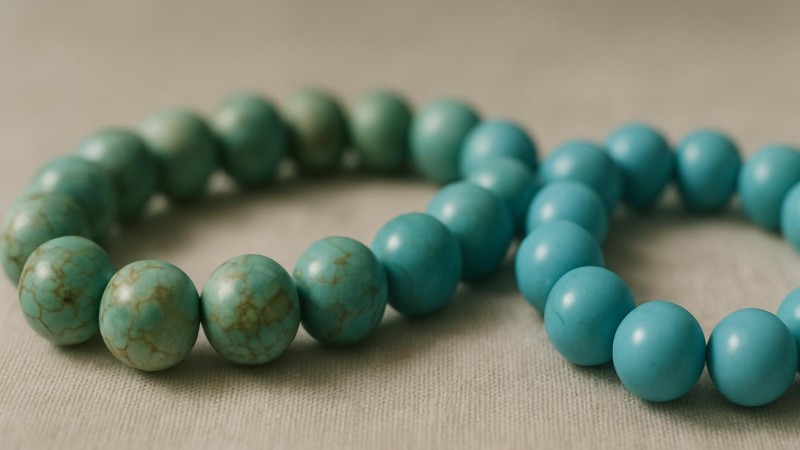
Untreated turquoise often shows subtle, nuanced colour rather than a perfectly uniform bright blue. Some stones are robin’s egg blue, while others lean greenish blue, sage green, or pale sky blue. Matrix may appear as brown, tan, black, golden, or spiderweb-like veining depending on the deposit. Because untreated turquoise is often porous, it can also be softer and more sensitive than heavily treated material.
In folklore and historical traditions, turquoise was associated with protection, travel, and good fortune in many cultures. That long cultural legacy contributes to its enduring appeal in artisan jewellery and beadwork today.
What Does “Dyed Turquoise” Mean?
Dyed turquoise is turquoise that has been artificially coloured to intensify, alter, or even out its appearance. In some cases, lower-grade pale turquoise is dyed a richer blue or green. In other cases, a different porous material such as magnesite or howlite may be dyed and sold in a turquoise-like colour. This is where buyers need to be especially careful, because “turquoise-coloured” is not the same as genuine turquoise.
Dyeing may be done alone or combined with stabilisation. Stabilisation generally means infusing porous turquoise with a resin or similar substance to improve durability and polish. Stabilised turquoise can still be genuine turquoise, but it is not untreated. Dye may then be added to deepen the colour further.
For jewellery designers working with amethyst beads or other gemstone components, treatment disclosure matters because it affects value, care requirements, and how materials should be described in product listings or custom commissions.
Why Turquoise Is Often Dyed or Treated
Turquoise is naturally porous, and high-quality untreated material is relatively limited. Dyeing and other treatments are common for several reasons:
- To intensify colour: Pale material can be made to look richer and more saturated.
- To create uniformity: Bead strands often sell better when the colour matches closely from bead to bead.
- To improve marketability: Bright blue stones are especially popular.
- To mimic premium sources: Lower-grade material may be made to resemble more desirable turquoise.
- To enhance durability: Dye may accompany stabilisation in porous stones.
These treatments are common in the gemstone trade. The problem arises only when dyed or imitation material is presented as natural untreated turquoise without disclosure.
Dyed Turquoise vs Imitation Turquoise
One source of confusion is that not all dyed “turquoise” is actually turquoise. Some beads sold in bright turquoise shades are dyed howlite, dyed magnesite, composite material, or reconstituted stone. These can still be attractive for fashion jewellery, but they should not be described as natural untreated turquoise.
Common look-alikes include:
- Dyed howlite: Usually white with grey veining before dyeing; often coloured bright blue.
- Dyed magnesite: Porous and easily dyed, sometimes sold as turquoise.
- Reconstituted turquoise: Small turquoise fragments bonded with resin and dye.
- Composite blocks: Powdered minerals and binders formed into beads or cabochons.
If you are mixing turquoise with natural materials such as sterling silver clasps, gemstone rounds, or shell components, accurate labelling helps preserve the integrity of your finished work.
Questions to Ask Before You Buy
One of the smartest ways to identify dyed versus untreated turquoise is simply to ask clear, specific questions. Reputable sellers should be able to answer them directly.
- Is this genuine turquoise?
- Is it natural untreated, stabilised, dyed, or reconstituted?
- Has the colour been enhanced in any way?
- Are the photos of the exact item I will receive?
- What is the origin, if known?
- Can you provide close-up photos of matrix and drill holes?
Be cautious with vague wording such as “natural colour” or “turquoise stone” if the listing does not clearly disclose treatment. In gemstone sales, precise language matters.
How Sellers Commonly Describe Turquoise
Understanding terminology can save you from disappointment. Here is what common phrases usually mean:
- Natural untreated turquoise: Genuine turquoise with no added colour or stabilisation.
- Natural turquoise: Sometimes used loosely; ask whether it is stabilised or dyed.
- Stabilised turquoise: Genuine turquoise treated for durability, but not necessarily dyed.
- Colour-enhanced turquoise: Usually dyed or otherwise artificially intensified.
- Reconstituted turquoise: Ground material bonded together; not solid natural turquoise.
- Turquoise howlite/magnesite: Not turquoise, but another stone dyed to resemble it.
When in doubt, ask for clarification in writing before purchasing.
When Professional Testing Makes Sense
If you are purchasing a high-value piece, building a serious collection, or need certainty for resale, a professional gemmologist can help identify whether a stone is turquoise and whether obvious treatment is present. Laboratory testing may include magnification, spectroscopy, refractive properties, or advanced analytical methods beyond what most buyers can do at home.
This is especially useful for antique jewellery, Native American style pieces of uncertain origin, or rare stones represented as premium natural untreated turquoise.
Leave a Comment