

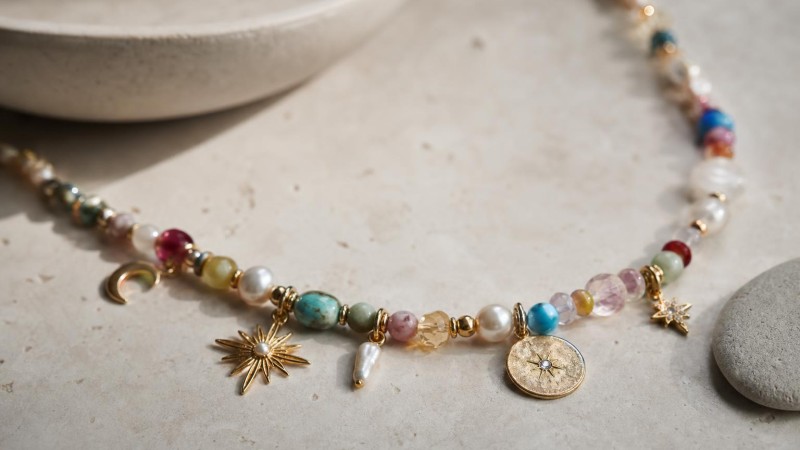
Minimal chains will always have a place in the jewellery box, but necklaces are getting bolder, more colourful, and much more personal. Maximalist beaded charm necklaces bring together gemstones, pearls, glass, metal findings, symbolic pendants, and playful objects in combinations that are deliberately abundant rather than restrained. Instead of following a strict matching formula, these pieces celebrate collecting, layering, contrast, and individuality.
The trend also has unusual staying power because it can be interpreted in so many ways. A necklace might combine polished natural stones with vintage-inspired charms, or pair lolly-coloured beads with substantial metal hardware. Another may feel like a miniature cabinet of curiosities, with every element suggesting a memory, place, hobby, or symbol. For jewellery makers, that freedom makes the maximalist charm necklace an especially rewarding format for experimentation.
What Is a Maximalist Beaded Charm Necklace?
A maximalist beaded charm necklace typically features a strand of noticeable beads plus multiple charms, pendants, drops, or decorative findings. The beads may repeat in a regular pattern, but many contemporary designs intentionally mix colours, sizes, shapes, and materials. The result is visual abundance with enough structure to remain wearable.
Maximalism does not simply mean attaching everything available to one strand. Successful designs use contrast strategically. A maker might alternate saturated stones with neutral freshwater pearls, for example, giving the eye quieter intervals between stronger colours and dangling details.
Scale is another defining feature. Chunkier beads, oversized pendants, clustered charms, and substantial clasps tend to make a greater statement than the tiny components associated with delicate jewellery. Yet a necklace can still feel maximalist when made with smaller materials if it uses plentiful charms, complex colour, or dense layering.
Why Charm Necklaces Are Having a Moment
Fashion often moves like a pendulum. After extended periods dominated by subtle chains and restrained styling, expressive jewellery offers a fresh visual vocabulary. Colourful necklaces can transform a simple shirt, jumper, or dress without requiring an entirely new outfit, while interchangeable charms make jewellery feel less fixed and more customisable.
There is also a broader enthusiasm for objects that appear collected rather than perfectly coordinated. Modern charm necklaces can reference travel souvenirs, talismans, heirloom jewellery, craft traditions, childhood trinkets, or natural materials. Even when every component is new, thoughtful variation can create the appealing impression that a necklace has developed its personality over time.
Social media has amplified the style because intricate pieces reward a closer look. One photograph can reveal striped agate, irregular pearl surfaces, tiny metal motifs, translucent glass, and carved stones. But the trend works beyond the camera: texture and movement become even more apparent when the necklace is worn.
A Long History Behind the Modern Look
Beads and pendants are among humanity's oldest forms of personal adornment. Across different periods and cultures, people have worn natural materials, shells, stone beads, metals, amulets, and symbolic objects for decoration, identity, status, remembrance, trade, and ritual purposes. Today's fashion should not flatten these diverse traditions into a single origin story, but the longstanding human impulse to collect meaningful objects helps explain the enduring attraction of charm jewellery.
Gemstones can add another historical dimension. Amethyst, for instance, has accumulated many symbolic associations across centuries; in different traditions it was connected with ideas such as sobriety, clarity, or protection. Such associations belong to history and folklore rather than medical evidence, but they can still inspire a personal jewellery design. A strand incorporating amethyst beads might therefore be selected for its rich violet colour, its traditional symbolism, or simply because the wearer likes the stone.
The Building Blocks of a Maximalist Necklace
Natural Stone Beads
Gemstone beads provide colour, weight, pattern, and organic variation. Agates can introduce bands and earthy markings, quartz varieties add translucency, and jasper offers a broad range of landscape-like colours and patterns. Because natural stone varies from bead to bead, even a relatively simple strand already has visual complexity.
Pay attention to finish as well as colour. Highly polished gemstone beads reflect light differently from matte or faceted surfaces. Mixing two finishes can add depth without introducing another colour, which is useful when the charm selection is already busy.
Pearls, Glass, and Contrasting Materials
Pearls are particularly effective in maximalist compositions because their organic shapes can soften hard-edged metal components and brightly coloured stones. Glass provides another useful counterpoint: transparent, opaque, lampwork, and pressed forms can introduce colours or shapes that may be difficult to achieve with natural stone alone.
Do not assume that every component must share the same degree of polish. An irregular pearl next to a faceted bead and a slightly antiqued metal charm creates tactile variety. Repeating each texture at least once elsewhere in the necklace helps make intentional contrast look cohesive.
Charms, Pendants, and Findings
Charms create the narrative. Celestial motifs, botanical shapes, animals, lockets, keys, hearts, coins, and abstract forms can all establish a theme. They need not match exactly; two or three related ideas are often enough to create a connection.
Small findings matter just as much as decorative elements. Correctly sized jump rings help charms articulate freely while connecting them securely to suitable attachment points. Before assembly, check ring diameter, wire thickness, metal compatibility, and the size of each charm's loop rather than assuming every component will fit together.
How to Design Maximalism Without Creating Visual Chaos
The easiest approach is to begin with one anchor. Choose a central pendant, a favourite stone, or a small palette of two to four principal colours. Other decisions can then respond to that anchor. If the centrepiece contains green and warm gold tones, for example, surrounding beads can repeat those colours while cream or clear elements provide breathing room.
Next, establish rhythm. Instead of creating a completely random strand, repeat selected forms at irregular-looking but intentional intervals. A pearl might appear every few centimetres, or one colour could recur on both sides of the centre without being perfectly symmetrical. This creates what might be called controlled mismatch: lively enough to feel spontaneous, structured enough to feel designed.
Useful composition principles include:
- Repeat something. Carry at least one colour, material, shape, or metal tone through multiple areas of the necklace.
- Vary scale. Combine smaller supporting beads with several larger focal components rather than making everything compete equally.
- Leave tiny pauses. Simple beads or short quieter sections help individual charms remain visible.
- Distribute visual weight. Avoid placing every large, dark, or metallic component on one side unless asymmetry is an intentional feature.
- Test movement. Make sure neighbouring charms do not constantly snag, overlap awkwardly, or block the focal pendant.
Choosing a Colour Palette
Maximalist colour can be exuberant without being arbitrary. One accessible formula starts with a dominant colour, adds one contrasting hue, and finishes with a neutral such as cream, smoky grey, brown, black, or metallic gold or silver. A more adventurous option is an analogous palette using neighbouring colours such as blue, turquoise, and green.
Natural stones make sophisticated colour combinations easier because many contain several hues in one bead. agate beads may include bands, inclusions, and tonal changes that effectively bridge other materials. Instead of matching every element exactly, look for small shared colours that visually connect the necklace.
Metal colour also participates in the palette. Warm-toned findings can emphasise amber, coral, brown, pink, and green, while cool-toned metals often complement blues, purples, clear stones, and monochrome schemes. These are starting points rather than rules; mixing metal colours can itself become a deliberate maximalist feature.
Practical Construction Tips for Jewellery Makers
A dramatic necklace still needs sound construction. Lay out the entire design before permanently finishing the ends, preferably on a bead board or a stable work surface where the sequence will not roll away. Photograph promising layouts as you experiment so you can compare versions without trying to remember each arrangement.
Select stringing material according to bead weight, hole size, and construction method. Heavier stone beads place more stress on a necklace than lightweight seed beads, so component compatibility is important. When working with flexible beading wire, correctly matched crimp beads and finishing hardware are essential parts of the construction system; follow the material manufacturer's specifications for diameter and technique.
Tools also affect finish quality. Smooth-jaw pliers can help reduce unnecessary marking on findings, while suitable cutters create cleaner ends. For wire loops, wrapped components, or custom connectors, appropriately sized round nose pliers give greater control over loop diameter and consistency.
Before declaring the necklace complete, inspect every connection and run a fingertip carefully around finished areas for rough wire ends or sharp edges. Hold the piece vertically to see how the charms actually fall under gravity. Then place it on a display form or flat neckline template to check balance and spacing from the perspective in which it will be worn.
How Many Charms Should You Use?
There is no required number. Three larger charms can create a strong statement, while a necklace with a dozen small drops can feel richly detailed without becoming physically bulky. The useful question is whether each addition improves the composition. If another charm obscures an existing focal point or makes several components tangle, abundance has stopped serving the design.
Try adding charms gradually. Start with the primary pendant, place two supporting charms at different distances, then add smaller pieces between them. Removable connections or charm clasps can make later rearrangement easier when they are appropriate for the design and load.
Ways to Style Maximalist Beaded Charm Necklaces
Because the necklace already supplies substantial detail, a simple neckline can act as a useful background. A white shirt, black knit, denim layer, or solid-colour dress allows saturated gemstones and metallic charms to stand out. That does not mean other accessories must disappear; maximalist styling can include earrings, bracelets, and rings, provided repeated colours or materials create some relationship between them.
Layering offers another approach. Pair the main beaded necklace with a shorter plain chain or a longer, relatively simple strand so the necklaces occupy different levels rather than competing in the same space. Check that clasps, charms, and textured beads do not catch on one another during movement.
Necklace length changes the overall effect too. A shorter strand places colour close to the face and works well with open collars, while longer designs provide more room for large focal pendants and clusters. Always account for the length added by the clasp and connectors before final assembly.
Caring for a Mixed-Material Necklace
A necklace combining stone, pearl, glass, and metal should generally be cared for according to its most delicate component. Rather than assuming one cleaning method suits everything, identify the materials first. Some gemstones are porous, soft, treated, dyed, or otherwise sensitive to particular chemicals, moisture, heat, or abrasion.
As a practical routine, put jewellery on after cosmetics, fragrances, or styling products have dried, wipe suitable surfaces gently after wear, and store the necklace so dangling charms cannot scrape softer beads. Separate storage also reduces tangling. Consult material-specific care guidance when a stone or finish is unfamiliar.
Making the Trend Personal
The strongest maximalist necklaces are not necessarily the most crowded. They are the ones with a recognisable point of view. A maker who loves coastal colours might combine pearl, aquamarine-toned materials, shells, and silver-coloured findings. Someone drawn to autumn palettes could explore jasper, carnelian-coloured beads, warm metals, and botanical motifs.
Symbolism can provide another design framework. In historical traditions and folklore, stones have been associated with everything from courage and luck to protection and friendship. These meanings vary greatly across cultures and eras and should be treated as traditional associations, not scientific or medical properties. For many wearers, however, choosing a stone for a story, memory, birth month, or personal interpretation makes jewellery more engaging.
A Trend Built for Collectors and Makers
The rise of maximalist beaded charm necklaces reflects a broader appetite for expressive, customisable jewellery. Their appeal comes from contrast: polished beside irregular, precious-looking beside playful, old-fashioned motifs beside contemporary colour. No two collections of materials need produce the same result.
For makers, the best way to explore the style is to start with a focal component and build outward slowly. Choose a limited foundation palette, vary texture and scale, repeat a few details, and test the necklace for balance as often as appearance. Whether assembled from favourite supplies already on the workbench or newly selected materials from PebbleBead, a maximalist charm necklace offers something particularly satisfying: the freedom to turn a collection of small objects into one coherent, wearable story.

Leave a Comment